Pages

Showing posts with label circuits. Show all posts

Friday, April 4, 2014

Exploring Circuits


Completing the 15 circuits in the Arduino Inventor kit earlier this semester was the perfect entry point for me to learn more about programmable circuits.  There was just enough documentation to support my progress through each of these circuit exercises, but not so much that I felt like I was just walking through the steps.  I had just enough background in programming (which is not much) to start to tweak the code and remix and mashup some of the circuit examples.   However, I kept thinking that this would not be the correct entry point for someone who has had NO background in programming.  So even though the Arduino provides a HIGH CEILING environment for creating,  I don't feel it was low threshold enough for most learners to easy start creating. 

My past experience with Pico Crickets has allowed me to see the type of learning that happens when you have LOTS of arts and craft materials,  Legos,  Sensors, and a low threshold programming environment.  Since PicoCrickets have been retired,  I embarked on a mission to find many different "on ramps" to the world of programmable circuits for different types of learners. 

After seeing some of the products showcased at the Sparkfun table at SxSw I placed an order for a Makey Makey and lots of LillyPad (eTextile) components. It was hard to know which components would be the easiest to start with, so I ordered a variety of different pieces.  My 'mentor' (also my husband)   suggested that I figured out what I wanted to create so I could select the 'right' pieces,  but it's hard to know what you CAN make until you have had a chance at some open play with the tools to see what's possible. 

Several hundred dollars later,  a package from Sparkfun arrived that contained  Lilypad circuits, LED's, and all types of conductive materials (thread, paint, fabric, tape, etc) 


My mind started to imagine all types of possibilities with the components I had ordered.  I wandered through the craft section at Walmart and the Michael's store with a very different lens.   After picking up a few hundred dollars worth of materials and/or inspiration,  I was eager to start playing.

A brief visit to Michael's 

Inspiration from Walmart


While I was drawing ideas for what might become an adhesive walking advertisement for Creating and Making - somehow adhered temporarily or permanently on my book bag,  FED EX delivered another package I had ordered from Little Bits.  In the box were  two Little Bit kits to explore circuits that seemed to have the potential to introduce our youngest learner to the Internet of Things.  Very much inspired by  Little Bit creator, Ayah Bdeir, whose workshop I attended at  SxSw,  I ordered the Premium Kit and the Korg Synth Kit.


If you are not familiar with Little Bits, the best way to learn about Little Bits is from the creator -Ayah Bdier, herself.


Since I was flying back to Vermont this week for 3 professional development events and to spend time with grandchildren,  I had all these packages delivered at my grandson's home.  Watching what happens when packages like these show up at the home of an 8 year old and 2 year old brought lots of new insights (which I will share in another blog post).  But needless to say - my  "planning week"  for my Final Project was spent  exploring lots of possibilities,  and using the eraser end of my pencil as I tried out different ideas on paper and in my head.


Tuesday, February 11, 2014

I See the Light - Exploring the world of Microprocessor Circuits


I See the Light - Exploring the world of Microprocessor Circuits
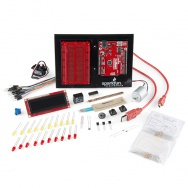
My learning journey in the world of physical computing continues to bridge the experience gap for me as I complete the 15 circuits from the the SparkFun Inventor’s Kit for the SparkFun RedBoard.


As I worked through these circuit building exercises from my Intro to Physical Computing Course from Marlboro College Graduate and Professional Studies, I became more deeply aware of how the experience gap widens as kids miss out on the opportunity to learn some basic science about the world around them.  I’m not sure when budding scientist usually get introduced to circuits, but I don’t remember it from my elementary school days.  It certainly didn’t happen in my household of 5 girls.  I don’t have any memories of doing this type of thing with my parents either. So by the time I got to high school, I found myself accepting the fact that my understanding of the world of science was “muddy” and learned to live with that and cope.  I put off taking Chemistry until my senior year, and then used my ability to ‘play school’ well to get through that without any deep understanding.  Needless to say, I never made it into any physics classes.  


I was pleased to learn that my science/math distribution requirements in college could all be fulfilled with math classes, which offered me yet another way to stay in the dark with my understanding of science.  Ironically  I am fascinated by science and frequently in awe of engineering, but I’ve learned to accept that this is something I can enjoy the marvels of without ever being able to do it (or truly understand it) myself.  After all, we can all enjoy music without being able to play an instrument or art without being able to draw or paint -  so it must be with science.  Maybe!  But by curiosity always made me wish I could have had a deeper understanding of so many wonders that could be explained by science.  I learned to accept the fog--which of courses increased the gap in experience and in understanding. [photo credit: doug.siefken via photopin cc]


As I proceeded through the first couple of projects in this Inventor Kit, I had a real meltdown.  Circuit 1 was pretty easy to put together. But as I was completing Circuit 2, I became very aware of my lack of any deep understanding of what was happening outside my ability to follow directions and assembling wires and components accordingly. The tension made me want to shut down and not move further.  There was no way that I would be able to complete the next 14 projects feeling this incompetent. So I took a step back and did what I usually do when I feel over my head - and that is to become a student and tune into my learning style.  I copied the code to the circuits into a Google doc and started to break it apart 1 line at a time, using yellow to highlight important concepts, orange to highlight any actual snippets of code as I dissected it, and pink to  highlight any points of confusion that remained.  The comment feature allowed me to add free form thoughts and ideas as I worked through the circuits.


But that was not enough.  I was seriously lacking some very basic basics.  Thankfully my husband is an engineering type and was more than willing to help me fill in the gaps.  After some of the fog had lifted about the basics of circuits and circuit boards,  I went back and redid the first project and moved through the next several projects with increased confidence each time.


By circuit 3 I was able to look at the little schematic and understand what was going to happen, even before I turned the page and read on.  I found myself color coding the wires I selected according to the energy flow and polarity.  Anything that went to + or 5 volt got a red wire.  Anything that went to ground got a black or white wire.  Wires back to certain pins got a different color.  As my confidence and understanding grew I started playing with positioning the wires and resistors in locations that worked for me that would yield the same results. I ran into another challenge when I hit the project that introduced transistors and relays. My curiosity and unwillingness to wander in a state of fog lead me to grill my coach/mentor/husband once more until things became clear enough for me to have a basic understanding of the role of transistors and relays in circuits.  


I completed a video of each circuit as I completed it.  Explored it further by playing with the code and then sailed through most of them (except 14 - which gave me a real hard time).  Here is my documentation.


I had 3 circuits to complete by the time we had to leave Grayton Beach, Florida on Monday, but I managed to complete and shoot the video documentation for those last 3 circuits on the road while we travelled from the Florida, through, Alabama, Mississippi and Louisiana.


Throughout this wonderful learning opportunity, I found myself thinking about the importance of  Curiosity, Confidence, GRIT, Motivation and understanding your learning style.  Had I not had the curiosity, I would have never sought out this experience; had I not had the motivation and GRIT, I would have given up; had I not had the understanding of my learning style, I would have failed to see a way through the challenges and had I not gained confidence along the way, I would not have enjoyed any of it, nor built any desire to explore further.


In education today, we are doing more and more student centered learning, and offering students more choice in determining their learning path. But what does it take to create the curiosity, confidence, motivation for students to venture into unknown territories or discover areas of knowledge that might never cross their natural path? What if a desired path leaves you in the dark lacking major understanding of what is and what’s possible in our world? How can we move forward in the personalization of education without failing our children?  Providing access and opportunity to learn is not the same as providing students with the ability to reach beyond where their natural path or choices might take them.  My choices left me void of understanding of many scientific concepts.  But should my educational system have allowed this to happen? [ photo credit: Auntie P via photopin cc}]


Some would say this is why we have high stakes testing - to spot the failures and fix them.  But is that fixing the problem or making it worse. Not only do these test not reveal much data about Curiosity, Confidence, GRIT, Motivation and understanding one's learning style, they don’t yield improvements in the design of learning that increases any of these essential components. Often, they have done the opposite in that they have brought about an increased focus on remediation at the expense of creative learning environments that challenge learners to wonder, take risk, construct knowledge, and persevere. Finding a path where learners can experience that joy of thinking hard, where they have choice, follow their passions, and unpack their own understanding of the world without missing important and key understandings will not be easy - especially in a world where knowledge is growing at an exponential rate.  Thankfully people are still asking the important question of “How do we do this.. where is the path that will yield the best results?”  [photo credit: NASA HQ PHOTO via photopin cc]